4 Academic integrity

During your time at university you will find yourself faced with many decisions — about university, your career and your personal life. Many of these decisions will provide you with opportunities to grow your knowledge and skills, however sometimes they could tempt you to compromise your integrity.
Academic misconduct
Misconduct is the term used to describe any behaviour that undermines or compromises your integrity. Learn about the different forms of academic misconduct below.
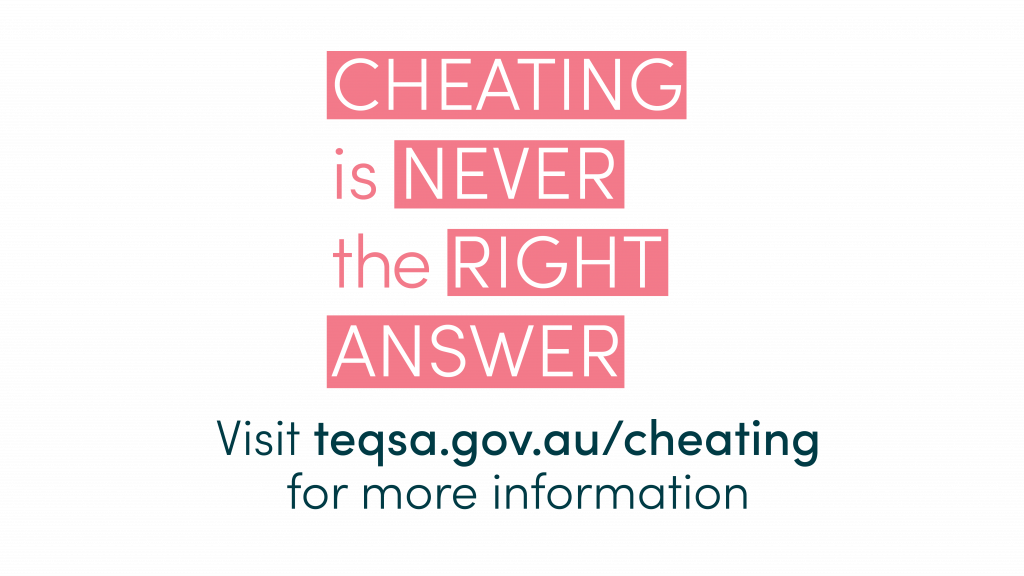
Cheating
Cheating at university can include such behaviours as:
- using materials such as notes or devices without permission in an in-person or online exam
- copying from another student
- sharing your answers with another student
- having someone else sit an exam on your behalf.
Consider this scenario:
Aoife has been working long hours and doesn’t feel prepared for her exam even though she has spent a lot of time studying and has a good grasp of the topic. She knows she can position her phone where the online software cannot detect her looking at answers her friend, who sat the exam the day before, has sent her instead of formulating her own. Aoife is cheating on her exam by trying to pass another student’s work off as her own.
Contract cheating
The Australian Governments Tertiary Education Quality and Standards Agency or TEQSA defines contract cheating as:
“…when students outsource their assessments to a third party, whether that is a commercial provider, current or former student, family member or acquaintance. It includes the unauthorised use of file-sharing sites, as well as organising another person to take an examination”
(Definition from Good practice note: Addressing contract cheating to safeguard academic integrity by Tertiary Education Quality and Standards Agency available under a CC BY 3.0 license)
Paid contract cheating services are illegal in Australia. They include websites and individuals or groups that market or provide cheating services to students and file sharing sites.
Examples of contract cheating include:
- paying for an essay from a contract cheating website
- paying a friend, peer, or relative to complete an assignment for you
- asking someone to complete part of an assessment for you
- sharing University lecture notes on a contract cheating website for credits or financial gain.
Consider this scenario:
Maria & Aarushi are working on a group project. They have found it hard to meet to work on it and the deadline is getting very close. Maria has found an online service that will provide the finished assessment item, including presentation slides and notes. They suggest that the two group members split the cost for the service so that it will take the pressure off and get them both good marks. Maria is suggesting that both group members participate in contract cheating to gain an advantage in their studies.
Plagiarism
Plagiarism is when you present someone else’s ideas or work as your own. It could occur in writing, design, music, film, software code and many other situations. Some examples include:
- handing in someone else’s work as your own
- copying words or ideas from someone else without giving them credit
- failing to use quotation marks when you quote someone’s words
- giving incorrect information about the source of a quotation
- changing a few words in a sentence but leaving the rest of it the same, with or without crediting the source
- handing in work that you already used for another assignment (self-plagiarism).
An important part of academic writing is acknowledging the ideas and work of others. When you do this, it allows your own analysis, ideas, and voice to shine.
Consider this scenario:
Basheer finds study notes online that answer part of his assignment question. He copies the notes exactly and changes only a few words in the hopes that it won’t get detected by plagiarism software or recognised by the marker. He is intentionally trying to pass off someone else’s work as his own.
Collusion
Collusion is when two or more students act together to cheat, plagiarise or engage in academic misconduct, or encourage others to do so. Some examples include:
- sharing answers for an online quiz in a group chat or deliberately sharing answers in a physical exam room
- giving part or all of an assignment you have written to a friend so they can copy it
- planning or co-writing a response to an individual assignment with another student.
Be aware that leaving your work in an insecure place where other people could copy it (e.g. leaving your laptop open, forgetting to collect your printing) can lead to collusion even if you do not intend to share your work.
Consider this scenario:
Jamie is taking a subject that their sister Hannah completed last year. Jamie asks if they can look at Hannah’s assignment because they aren’t sure how to answer the question. Hannah sends Jamie her completed assignment. Even though Jamie promises not to copy it, they are obtaining an unfair advantage.
What can go wrong?
If you don’t act with academic integrity, you are likely to face penalties which can include:
- facing the misconduct process of the university
- having to repeat and/or failing the assessment task or subject
- being suspended from your degree or subject for a period of time
- being expelled and/or losing your degree
- being denied entry into your chosen profession
- facing criminal charges.
Give yourself the best chance
The best way to avoid cheating is to be honest with yourself and do the work. Manage your time and be prepared.
- Read widely on your topic and collect the information for your assessment yourself.
- Analyse the information and write the assessment yourself.
- Speak to your lecturer before using any translation, artificial intelligence or other software or online tool to see if it acceptable for your studies.
If you are having difficulties with your studies, seek out help. You can speak to your lecturer or tutor, access Library services to help with your assessments, or reach out the University student support services.