5 Creative Commons licence types
As a creator of open content, you can choose the conditions of reuse and modification, with the following caveat:
When selecting a Creative Commons (CC) licence:
-
Aim to retain your rights, and make your content as open as permitted (authors are encouraged to anticipate their future needs and to retain the rights they need to optimise the dissemination of their research)
-
Consider other requirements, such as funder licensing and copyright restrictions for the IP or third-party copyright content used in your work.
For example:
You have grant funding, and your Funder stipulates a particular CC licence. Consider:
-
When selecting third-party copyright content, that you only use content that enables you to meet your Funder licensing requirements.
-
When you look for journals in which to publish, that you check that the Open Access journal offers the licensing required by your Funder. If it doesn’t, find another OA journal that does.
Optional licence elements
Along with the basic rights and obligations set out in each CC licence, there are a set of ‘optional’ licence elements which can be added by the creator of the work.
These elements allow the creator to select the different ways they want the public to use their work. The creator can mix and match the elements to produce the CC licence they want. This process is a simple and quick way for creators to indicate how they wish their work to be used.
Each element has its own icon and abbreviation, making them easy to identify. There are four standard licence elements:
Optional Licence Elements
| ICON | RIGHTS | DESCRIPTIONS |
 |
Attribution (BY) |
You let others copy, distribute, display, and perform your copyrighted work — and derivative works based upon it — only if they give credit the way you request.You must attribute the original work when you create an adaptation. |
 |
ShareAlike (SA) |
Derivatives are licensed under the same or compatible licence as the original.By definition, the ShareAlike licences have very few compatible licences. |
 |
Non-commercial (NC) |
You let others copy, distribute, display, and perform your work — and derivative works based upon it — but for non-commercial purposes only. |
 |
No Derivative Works (ND) |
You let others copy, distribute, display, and perform only verbatim copies of your work – but not derivative works based on it.It lets you make and use changes privately – but you cannot share your adaptation with others.However, if the content is copied without changes, the copy is not considered a derivate. |
Attribution: Text is a derivative of definitions provided in A Basic Guide to Open Educational Resources by Commonwealth of Learning licensed under CC BY-SA 4.0
Six standard Creative Commons licences
These elements are mixed and matched to create the six standard CC licences. The table below lists these licences and the conditions attached to each.
Note:
-
All six CC licences include the attribution (BY) element, meaning anyone using a resource with this licence must credit the author of the original work. Conversely, the ‘CC0’ Public Domain licence does not require attribution.
-
CC licences are written in the format ‘CC’ followed by a space and then the relevant licence elements combined with hyphens.
Six main Creative Commons licences
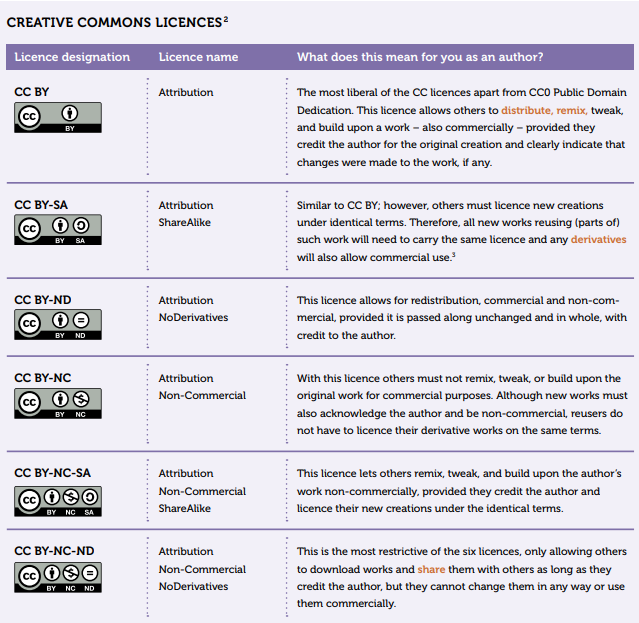
This short video explains the six main Creative Commons Licences.
Video: Creative Commons Kiwi [Creative Commons Kiwi video transcript (RTF download)].
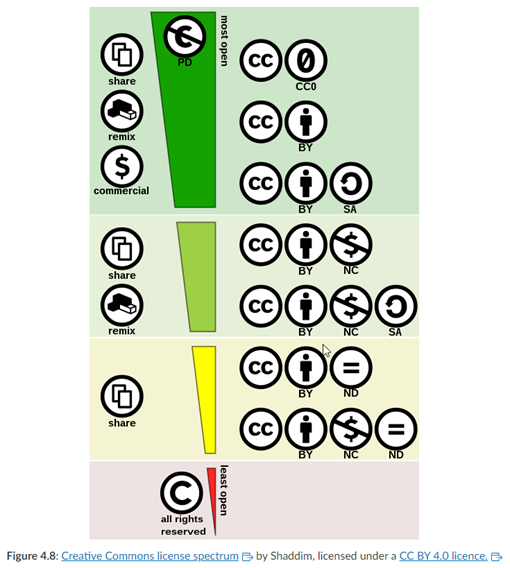
Creative Commons licence spectrum
The following chart depicts the spectrum of Creative Commons licences.